

Guidelines for Infection Prevention & Control 2021 Released By The ADA

It’s a complicated business whenever a dental practitioner applies for, or renews their registration. In doing so, they undertake to comply with all relevant Commonwealth and state legislation related to the practice of dentistry and the clinic to which they are affiliated. Standards must be upheld; most notably their agreed compliance with the Dental Board of Australia (DBA) regarding standards, codes, and guidelines.
Including the Board’s current Guidelines on Infection Control.
In Australia, a combination of guidelines, standards and manuals underpin all requirements in infection prevention and control across all healthcare providers. In most instances, the rules and regulations are compiled for the broader health aspect of hospitals and other clinical settings rather than dentistry explicitly. The ADA’s Guidelines for Infection Prevention and Control serves as the resource for current requirements and ready application for dentists and their teams.
In the interest of public health and safety – always at the forefront of the profession – it’s a free publication that recognises the specific challenges posed by dental environments in the intricacies of infection control.
The ADA strives to apply these complex standards in a practical way.

It’s a practical guide that includes all supporting scientific references driving the decided protocols.
Where no evidence is available for the specific issues of dental clinics in comparison to other health provision sites, the ADA draws upon current international best practice, expert knowledge and advice. Guidelines are reviewed and updated in consideration of emerging research and improvements in any category of infection control, including the reprocessing of reusable dental instruments and equipment.
It is a stipulation of the Dental Board of Australia that dental practitioners practise in a way that maintains and enhances public health and safety, and ensures that the risk of spreading infectious diseases is prevented or minimised. Practitioners must of course, ensure that the premises in which they practise are kept clean and hygienic.
In attending to a patient, dentists are required to adopt practicable procedures. The transference of bacteria, viruses, and fungi between one patient and another, from practitioner and dental staff to patient, and from patient to dental practitioner and/or staff is a complicated dynamic. The close proximity of patient/dentist/team, and the high risk of saliva and blood droplet transmission during even routine procedures makes the Guideline a necessarily complex undertaking, and a succinct document.
Talking, coughing, and sneezing expel contaminated respiratory droplets. Transmission occurs directly, or via contaminated hands to the susceptible mucosal surfaces of the eyes, nose or mouth.
A separation distance of 1.829 m (6 feet) serves as an evidence-based measure of how far particles travel in a straight line from a cough or sneeze.
Prudent, in terms of how far away a clean item, like an opened box of gloves, can be from a patient’s mouth if it’s positioned directly in front of the dental chair.
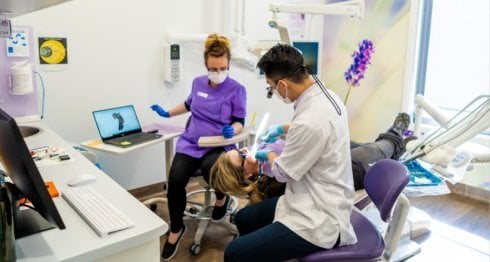
Standards Australia is another relevant body in the compilation of the ADA’s Guidelines, in defining requisite instrument reprocessing standards. Successful infection prevention and control involves understanding basic principles of infection prevention and control, and creating systems that can be effectively implemented. Clear procedural documentation, comprehensive and ongoing training, and a process of regular monitoring makes it less complicated and stressful for the practitioner. Maintaining compliance also includes current knowledge of new or re-emerging infectious diseases.
This is particularly pertinent not only for COVID-19, but newly evolving strains of ‘flu viruses, and increasingly antibiotic-resistant organisms.
The spread of microorganisms resulting in clinical infection depends in part on the virulence of a particular microorganism, and the susceptibility of the host. Age, general state of health, underlying illnesses, and impaired immune status (due to medical treatment, medication or deficiencies) are factors that are taken into account by the ADA its prevention guidelines.
Guidelines for Infection Prevention & Control 2021 Released By The ADA
Dental practitioners have a legal duty of care for their patients and it is a breach of anti-discrimination laws to refuse to treat, or impose extra conditions on patients with blood borne viruses such as hepatitis B, C and HIV.
It’s complicated.
It’s complicated, it’s necessary, and it’s adhered to by every dentist in the country because they care about you, and they care about your oral health.
You should do the same.
Note: All content and media on the Sunbury Dental House website and social media channels are created and published online for informational purposes only. It is not intended to be a substitute for professional medical advice and should not be relied on as health or personal advice.
Services we mentioned:

Related Articles
The Tooth Regeneration of Mice … And Men?
How is it that different tooth replacement strategies evolved? Which mechanisms prevent the replacement of human teeth? Homo sapiens, as we know, are limited to two sets of teeth; the second replaces our deciduous, or “baby teeth”. There are of course reptiles, fish,...
Caring For Older People And Their Oral Health
Since the 1970s, significant research has gone into quantifying the relationship between oral health and general wellbeing. Fifty years has extended this into biomedical and clinical perspectives that build broader understandings. The world population of people aged...
Can You Stop a Cavity Getting Worse?
You may not know what the bacterium Streptococcus mutans is, but you know what a cavity is. Also known as caries in both the singular and plural, they’re tiny holes in the teeth caused by surface bacteria creating acid from sugars. Somehow my brain interposes...
Chalky Teeth: Is the Writing on the Wall?
Chalky teeth. A term coined in 1920 by eminent 19th century physician and dentist Bernhard Gottlieb. He belonged to a group of Viennese scientists who originated orthodontics, periodontics, pedodontics, oral surgery and endodontics. Gottlieb described ‘chalky enamel’...